In a fleet, charging costs are not set by the energy price but by the peak load, the departure time and the question of who paid for which kilowatt-hour. What separates depot charging from simply installing charge points.
Anyone electrifying a fleet tends to budget with the energy price: so many kilometres, so much consumption, so many cents per kilowatt-hour. In operation it turns out that charging costs are driven by three quite different quantities — the peak load, the departure time, and the question of who paid for which kilowatt-hour.
All three are controllable. That is what "fleet optimisation" actually means.
The peak costs more than the electricity
Above a certain size a site is metered continuously: alongside the energy price per kilowatt-hour, the bill carries a demand charge per kilowatt per year — set by the highest quarter-hour of the billing year.
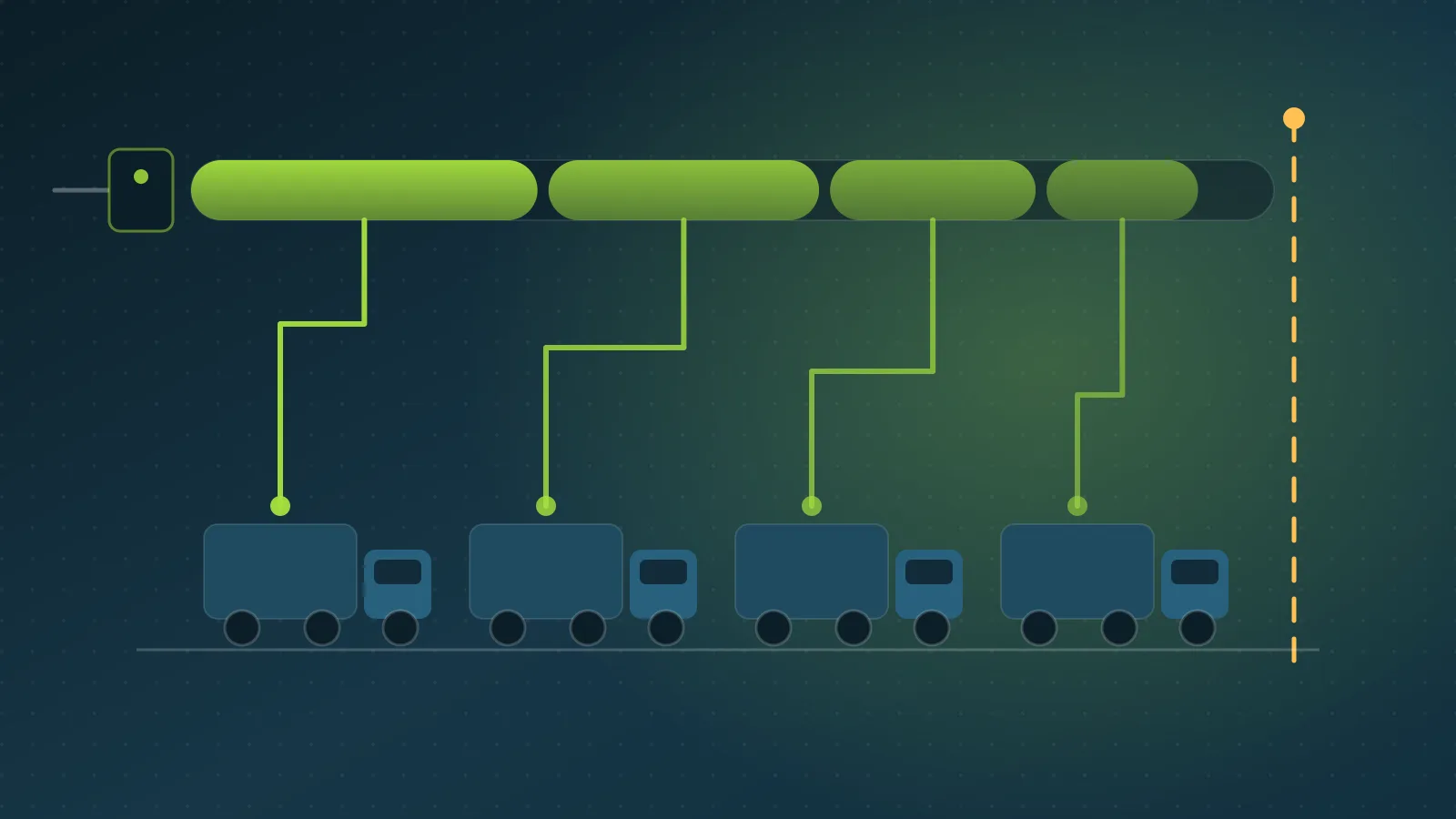
That construction is awkward for charging infrastructure. Twelve vans that plug in simultaneously at 18:15 and start at full power create one quarter-hour that gets paid for over twelve months — even though there was plenty of time until six in the morning. Load management that flattens this peak therefore saves in a place the energy price never reaches.
A second lever sits next to it: an operator who reliably keeps consumption outside the grid operator's high-load windows can, under the conditions of § 19 (2) StromNEV, agree a reduced grid fee. For a depot that charges at night anyway this is often the case — it just has to be demonstrable.
The constraint is departure, not charging time
A depot does not need to charge vehicles quickly. It needs to charge them in time. That is a completely different optimisation problem, and an easier one.
If the system knows that vehicle 7 leaves at 05:30 tomorrow on a 280-kilometre run while vehicle 3 is not needed until 14:00 for 40 kilometres, it can let both plug in at once and still charge them one after the other. Vehicle 3 waits without anyone moving a cable. Without that information, all that remains is fair equal distribution — under which both are half full at midnight.
In practice: departure times and target states of charge belong in the system that regulates the charge points. They are the most valuable input a fleet has, and the only one that cannot be measured.
Mixed fleets are the norm
Hardly any depot charges a single vehicle type. Cars at 11 kW AC, vans at 22 kW, one or two DC points for the quick top-up, plus the workshop heat pump and perhaps a PV array on the roof. Load management that reaches only one manufacturer's charge points over one protocol does not cover this site.
That is why aCharge DYLAMO connects over both OCPP and Modbus TCP and pulls heat pumps, inverters and transformers into the same control loop. What separates the expansion stages is set out in the product comparison.
The part that happens outside the depot
Two charging sessions per vehicle per week do not happen at the depot but at an employee's home or on the road. Both are cost centres, and both are sources of error.
Home charging of company cars. An employer can reimburse privately charged company-car electricity. For tax purposes there are two routes: monthly flat rates, or itemised settlement of the kilowatt-hours actually charged. The second is more accurate and considerably cheaper for high-mileage drivers, but requires the home wallbox to record sessions per vehicle and defensibly. Check the current flat-rate amounts and their validity with your tax adviser — they have been adjusted several times.
Public top-ups. These produce third-party records in third-party formats. What matters is that the sessions are attributed to the same vehicle as the depot charges — otherwise the cost centre is wrong and the greenhouse-gas quota cannot be claimed cleanly.
Attribution: per vehicle, not per driver
The most common design error in fleet projects is identifying the driver. Cards get swapped, vehicles change hands, hire cars run alongside — and at month end consumption can no longer be traced to the vehicle that had it.
Attribution belongs to the vehicle: an RFID card that stays in the vehicle or, where the technology allows, identification by the vehicle itself. How that can work without a card or an app is described in our article on Plug & Charge.
Everything else sits on top of that attribution: cost-centre reports, recharging to subsidiaries, metrology-compliant billing to third parties, and the analysis of which vehicle really consumes what. aCharge Cloud brings these sessions together regardless of which charge point produced them.
What to check
- Do you know your peak? Not annual consumption — the highest quarter-hour. It is on the grid invoice and it sets the demand charge.
- Are departure times in the system? If not, every night gives away optimisation potential that costs nothing.
- Does your load management reach every load? Charge points from several manufacturers, heat pump, PV — or only some of them?
- Is identification tied to the vehicle? Check before the first cost-centre report is due, not after.
- Is home charging settled? Flat rate or itemised — that decision determines what hardware employees need at home.
If you are planning a depot or retrofitting an existing one, get in touch — or see how businesses typically set this up.
As of 24 September 2024. Tax and grid-fee statements are general and do not replace advice on an individual case.
Questions about your charging infrastructure?
We're happy to advise you on load management, incentives, and the right aCharge product.
Request a consultation